EN
EN English
 Español
Why Does Welding Efficiency Matter In Industrial Metal Work?
Welding inside industrial spaces rarely happens as a single, isolated step. It sits in the middle of a chain. Before welding comes cutting or forming, after welding comes assembly or surface treatment. Once welding slows down, everything around it starts to feel the delay.
In real workshop conditions, the pressure is not only about speed. It is more about keeping movement steady. Metal parts keep coming in, workers wait for welded pieces, and small pauses can slowly build into visible bottlenecks.
What often gets overlooked is how repetitive welding really is. One frame may need a few joints, another may need dozens. Over a full shift, the same motion repeats again and again. If each cycle feels slightly unstable, fatigue grows faster and output becomes uneven.
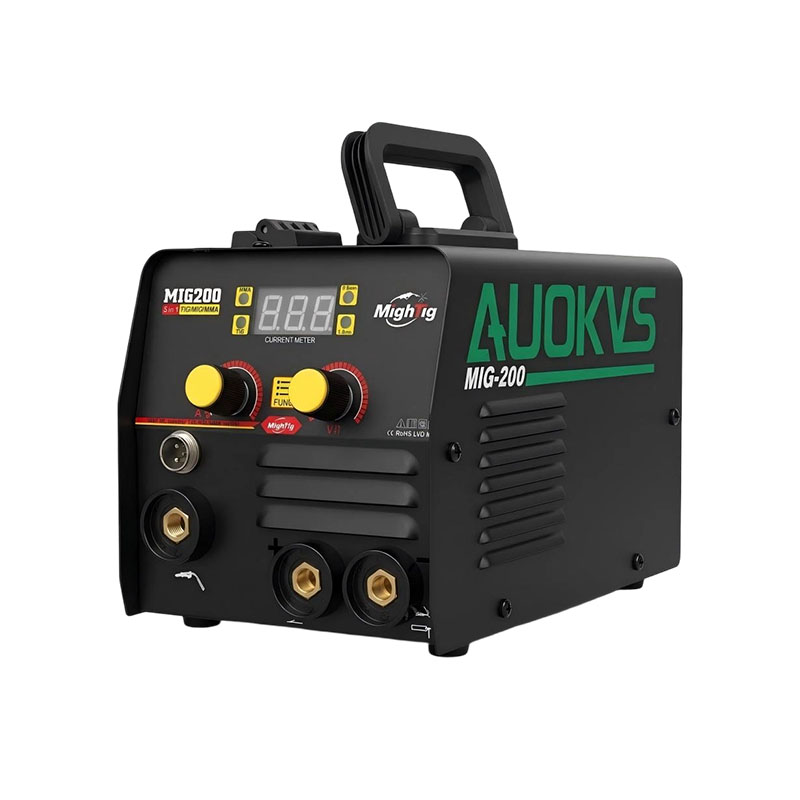
Industrial MIG Welding Machine is often chosen in these environments because it reduces unnecessary interruption. Not by changing the whole workflow, but by keeping welding motion more continuous and predictable.
What Is Industrial MIG Welding Machine And How Does It Work?
MIG welding is based on a continuous feeding idea. A thin wire moves forward through a feeding system while an electric arc forms between the wire and the metal surface. Heat melts both sides and creates a joint as the material cools.
At the same time, shielding gas flows around the welding area. Its role is simple: keep surrounding air away while metal is still in a liquid state. Without that protection, the surface would react differently during cooling.
Unlike older methods that need repeated electrode replacement, MIG welding keeps feeding wire without stopping. Once everything is adjusted properly, the process can run in a long, steady motion.
A simple breakdown of the process:
- wire moves forward through feeding channel
- arc forms at contact point
- heat melts wire and base metal
- shielding gas surrounds the weld zone
- molten metal cools into solid joint
On paper it looks straightforward. In practice, small changes in feed speed or arc behavior can affect how smooth the weld appears.
How Does Industrial MIG Welding Machine Improve Welding Efficiency?
Efficiency in welding is not something that comes from one single improvement. It is usually the result of several small changes working together. Less stopping, fewer adjustments, and smoother movement across joints.
How Does Continuous Wire Feeding Reduce Downtime?
In many traditional welding setups, work pauses when consumables run out or need adjustment. Even a short pause breaks rhythm. After restart, hand position, heat balance, and arc feel may need a moment to stabilize again.
MIG welding reduces that kind of interruption by keeping wire feeding continuous. The wire keeps moving forward without frequent replacement steps.
In real workshop flow, that changes how work feels:
- fewer stops between weld sections
- less time spent resetting equipment
- smoother transition from one joint to another
Over long production cycles, those small saved pauses quietly add up. Not in a dramatic way, but enough to change overall rhythm of the workday.
How Does Arc Stability Influence Efficiency?
Arc is where everything happens. If it feels steady, welding becomes predictable. If it shifts or breaks slightly, the hand needs to compensate.
In industrial MIG systems, arc stability is usually supported by controlled wire feeding and more balanced electrical output. When wire enters the arc zone evenly, the flame-like behavior stays calmer.
A stable arc does not just improve appearance. It also changes how the operator moves. Instead of constant correction, movement becomes more continuous.
In practice, better arc stability often leads to:
- less hesitation during long seams
- fewer corrections along the welding line
- smoother visual consistency across joints
It is not about perfection. It is more about reducing small disturbances that interrupt rhythm.
How Does Heat Control Affect Work Flow?
Heat spreads through metal during welding, and the way it spreads affects everything that comes after. Too much heat can bend or distort thin parts. Too little heat can leave weak bonding.
MIG welding systems often aim to keep heat more balanced during operation. When heat stays under control, welded parts do not require as much reshaping afterward.
That matters in production environments. Every extra correction step slows down flow. When parts come out cleaner, they move forward faster into the next stage.
Heat control also affects comfort during long operation periods. Less extreme variation in material behavior means less adjustment during work.
| Welding Aspect | More Interrupted Welding | Industrial MIG Welding Behavior |
|---|---|---|
| Wire Supply | Frequent stops | Continuous feeding |
| Arc Behavior | Uneven or shifting | More steady movement |
| Heat Effect | Irregular spread | More balanced control |
| Workflow Rhythm | Stop and restart pattern | More continuous flow |
What Role Does MIG Welding Machine Manufacturer Play In Efficiency Improvement?
Behind every welding machine, there is structural design that quietly shapes how it behaves during use. A MIG Welding Machine Manufacturer does not just assemble parts, but also decides how stable the system feels during long operation.
Internal energy control is one of those hidden factors. When electrical output stays steady, arc behavior becomes easier to manage.
Wire feeding design also plays a role. Even small friction inside feeding channels can change how smooth the arc feels at the tip.
Control interface design affects how quickly adjustments can be made. In busy environments, slower adjustment means more waiting time between changes.
Key design influences often include:
- steady internal power delivery
- smooth wire feeding mechanism
- responsive adjustment structure
- stable behavior during long use cycles
These parts are not visible in weld seams, yet they strongly influence how the machine behaves in real work.
How Does Technology Integration Affect Welding Performance?
Modern welding systems often include electronic control elements that help regulate energy and timing. Instead of relying only on manual adjustment, internal systems help stabilize output.
What Is The Role Of Inverter Technology?
Inverter systems help regulate electrical energy inside the machine. Instead of irregular flow, output becomes more controlled.
When energy flow stays steady, arc formation becomes easier to maintain. Welding motion feels less interrupted because arc does not change suddenly.
How Does Pulse Function Help With Precision?
Pulse control adjusts energy delivery in cycles rather than constant output. Heat comes in controlled intervals instead of continuous pressure.
That behavior is useful when working with thinner materials. It reduces the chance of surface distortion while still allowing proper joint formation.
How Is Industrial MIG Welding Machine Used In Production Environments?
In real industrial settings, MIG welding is rarely used alone. It connects with cutting, forming, and assembly stages.
Welding In Metal Fabrication Workflows
Metal fabrication involves repeated joining of frames, supports, and structural parts. Welding becomes a repeating step across long workflows.
When welding stays steady, movement through these stages feels more continuous. Less waiting between parts helps keep production rhythm stable.
Welding In Automotive And Repair Applications
Vehicle-related welding often deals with panels and body structure sections. Precision matters because nearby areas can be sensitive to heat and distortion.
Stable welding behavior helps reduce unnecessary correction work after welding cools down, which keeps repair flow more consistent.
What Factors Influence Welding Efficiency In Real Use?
Even with stable equipment, real working conditions still affect final output.
Material thickness changes require adjustment in heat and wire feed. Operator movement also plays a role in seam direction consistency.
Gas protection needs to remain steady to keep weld surface stable. Wire feeding consistency directly influences arc behavior.
Common influencing points:
- material variation during operation
- hand movement consistency
- gas flow stability
- wire feed smoothness
How Does Automation Influence Welding Efficiency In Real Work?
In many workshops, welding is no longer only a manual routine. Even without full robotic systems, parts of the process are quietly controlled by preset parameters and guided operation. Once settings are locked in, the machine tends to repeat the same behavior for a long stretch of time.
That changes the feeling of work on the floor. Instead of constant small corrections, welding continues with fewer interruptions. Operators still guide the process, yet the machine takes care of timing and wire movement in a more consistent way.
Over a shift, that difference becomes noticeable. Less stopping means less loss of rhythm. Welds across different sections also tend to look closer in behavior, since conditions stay more stable.
How Does Cooling System Design Support Continuous Welding?
Heat is always building inside welding equipment during long use. It does not stop, even when the weld looks stable on the outside. Without proper heat control, internal temperature slowly rises and performance begins to drift.
Cooling systems handle that background pressure. They keep internal parts within a working range so output does not swing too much during long sessions.
When cooling stays steady, welding does not need frequent pauses just to recover temperature. That alone changes workflow pace in a real production setting.
In daily use, stable cooling usually means:
- longer working cycles without interruption
- less performance change during extended welding
- more predictable arc behavior over time
- reduced downtime caused by heat buildup
Cooling is not something operators focus on directly, yet it quietly supports everything else.
How Does Industrial MIG Welding Machine Fit Into Production Line Flow?
In many production environments, welding is one step inside a larger chain. Parts arrive from cutting or forming, move into welding, then continue toward assembly or finishing.
If welding slows down or becomes irregular, the entire line starts to feel unbalanced. Other stations may wait or stack up unfinished parts.
A stable MIG welding setup helps keep that flow smoother. Once parameters are set, the machine can continue working in a consistent rhythm without frequent resets.
In practical terms, production flow becomes more even:
- incoming parts move at a steady pace
- welding station maintains continuous output
- downstream steps receive uniform pieces
- waiting time between stages becomes shorter
It is not about pushing speed higher. It is more about keeping movement from breaking.
How Does Material Compatibility Affect Welding Efficiency?
Different metals behave differently when heat is applied. Some respond quickly and change shape easily, while others need stronger and longer heat exposure.
Industrial MIG systems handle this variation through adjustable settings. Wire speed, heat level, and arc behavior can be tuned depending on material thickness and structure.
Thin sheets react fast, so control needs to stay gentle. Heavier pieces need more sustained energy to form a proper joint.
In real work, flexibility matters more than anything else. One machine handling multiple material types reduces setup changes and keeps workflow moving.
Typical behavior differences:
- thin metal: sensitive to heat changes, reacts quickly
- medium thickness: more stable fusion response
- mixed structures: uneven heat absorption across layers
When adjustment feels smooth, switching between tasks does not slow everything down.
How Does Wire Feeding System Design Affect Long-Term Stability?
Wire feeding sounds simple, yet it influences nearly every part of welding behavior. If feeding becomes uneven, arc stability changes immediately.
A smooth feed keeps wire entering the weld zone at a steady rate. That steady movement helps arc stay calm instead of fluctuating.
Inside the system, small friction or tension changes can affect how the wire reaches the tip. Over long sessions, even minor inconsistencies may show up in weld appearance.
When feeding stays stable, welding feels easier to control:
- arc behavior stays more consistent
- seam movement feels smoother
- fewer small interruptions during long runs
- less need for constant correction
It is one of those parts that is not always noticed, yet strongly affects final output.
How Does Industrial MIG Welding Machine Support Different Work Environments?
Workshops are rarely identical. Some focus on repair tasks, others on repeated production work. MIG systems adapt because they allow parameter changes without changing the core process.
In repair work, conditions change often. Operators adjust settings to match different parts and thickness levels. Flexibility becomes more important than repetition.
In production environments, stability matters more. Once settings are defined, the machine tends to run in a steady pattern for long periods.
That balance allows one system to move between different working styles:
- repair tasks with frequent adjustments
- production tasks with steady repetition
- mixed workflows within the same space
- reduced need for multiple machines
This flexibility helps simplify equipment planning inside workshops.
How Does Operator Interaction Affect Efficiency Over Time?
Even with stable equipment, human handling still plays a role. Hand movement, timing, and adjustment habits influence how consistent welds look across long sessions.
Still, MIG systems reduce the pressure on constant correction. Arc and wire behavior remain more predictable, so operators can focus more on direction than on fixing instability.
Over time, this reduces fatigue. Repeated small corrections become less frequent, and welding rhythm feels more continuous.
The change is subtle, not dramatic. It builds slowly through repetition.
Industrial MIG Welding Machine improves welding efficiency through steady feeding, stable arc behavior, controlled heat response, and adaptable system design.
What matters most is not a single feature, but how all parts work together during long operation. Less interruption, smoother transitions between weld points, and more stable output gradually reshape the workflow.
In real industrial use, welding feels less fragmented. Motion continues with fewer breaks, and production flow becomes easier to maintain across extended work periods.
 Previous